
Your needs, this model
Does it fit your priorities?
Is this a washer for occasional cars and household surfaces?
Yes. Those jobs are expressly described, with a 16.5-foot working hose and an onboard low-pressure detergent stage.
Explore this need in the finder →Can I choose it for daily paid cleaning?
No. The original SLPRWAS46 handbook prohibits commercial and industrial use.
Explore this need in the finder →Will its included working hose reach 20 feet?
No. The documented high-pressure hose is 16.5 feet. The longer electrical cord is not extra gun reach.
Explore this need in the finder →A compact household washer with a simple spray lance
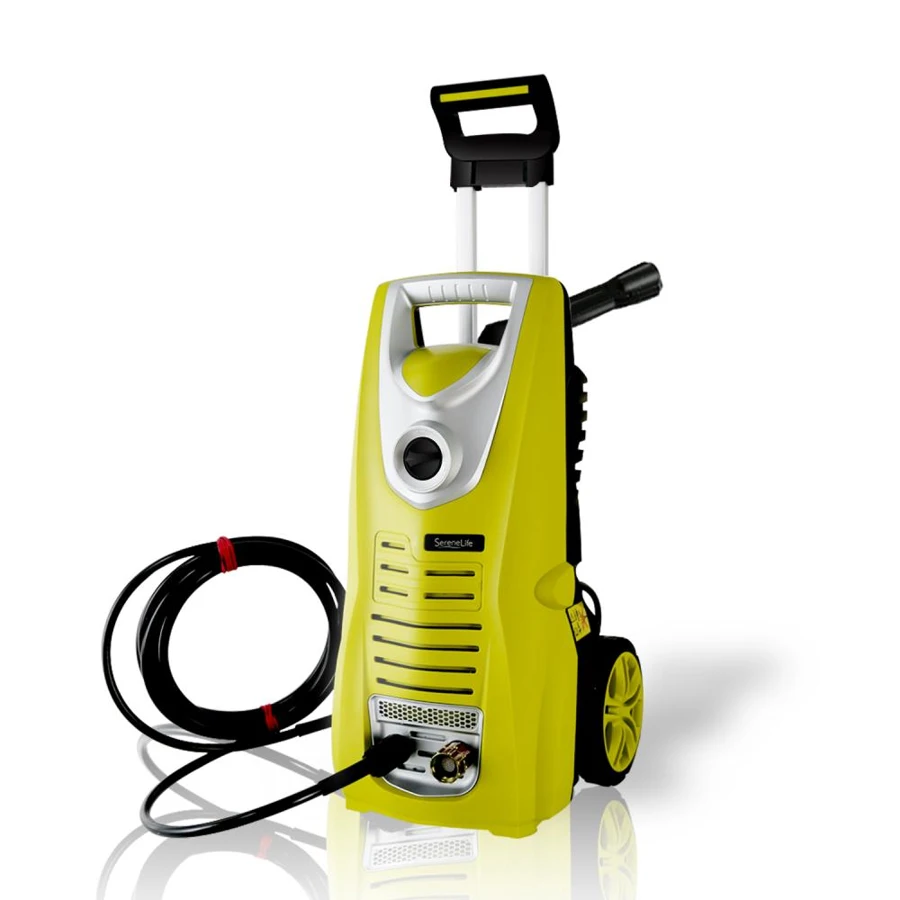
The SereneLife SLPRWAS46 suits someone wanting a conventional plug-in washer for occasional household washdowns, with a separate spray gun, rolling body and onboard detergent route. Its documented jobs include cars, boats, RVs, driveways and decks. The appeal is an uncomplicated setup near a suitable water tap and outlet, rather than an elaborate nozzle collection or a battery platform you already own.
It is important to be precise about what you are choosing. SereneLife's current product page and its original Pyle-hosted SLPRWAS46 handbook disagree on several performance and tank-capacity numbers. The consistent operating features are more useful here than trying to turn those conflicting headlines into a cleaning-speed promise.
Reach is modest and easy to understand
The manufacturer describes a 16.5-foot reinforced-PVC high-pressure hose and a 35-foot power cord. The working hose connects the machine to the gun. It is not a long suction line that lets the washer draw from a distant bucket. For a car, position the body so you can reach a useful section without pulling against the connections; expect to reposition it if the route around the vehicle exceeds the available reach.
The wheels and telescoping transport arrangement help move it across a suitable surface. The maker also describes a carry handle, but it does not provide a dependable ready-to-use carrying weight in these materials. Do not assume that a compact body will be comfortable on your stairs. A buyer with a strict lifting limit should choose a model with a clearly defined weight basis.
Stream and fan are not a calibrated pressure dial
The handbook describes stream and fan settings on the spray lance. This lets you change how the jet is distributed, which is useful when moving between suitable surfaces. It does not document an independent pump-pressure regulator or a numerical low-pressure rinse setting. If your requirement is genuine adjustable operating pressure, a variable spray pattern alone does not resolve it.
Use the more cautious pattern, distance and an inconspicuous test for paint, timber and vulnerable finishes. The narrow stream is not a universally better cleaning mode. Even an occasional household washer can damage a tire, force water where it should not go, or strip a finish if used carelessly.
Understand the soap step before filling the tank
The integrated detergent system is an actual operating feature. The original instructions distinguish low-pressure detergent use from the normal spray-lance rinsing arrangement. Follow that sequence, use a cleaner intended for the washer, and flush the detergent path afterwards. The tank is not evidence that concentrated chemicals are safe or that soap is injected at the same pressure as rinsing.
The current page describes a 700 ml tank, while the original handbook's final specification page says 400 ml. Verify the actual example rather than planning a whole cleaning session around either capacity. This difference does not erase the documented soap function; it means capacity is a package detail to confirm before buying.
Why we do not rank it by its headline output
The current manufacturer listing gives a 1,800 PSI maximum, but the original booklet uses a different maximum and a different bar figure. Its flow figures also contain inconsistent units. There is no dependable single working pressure-and-flow pair here for comparing timed driveway performance or meeting a firm minimum-output requirement.
If that technical threshold matters to you, choose a model whose exact operating documentation resolves it. If you simply want a household washer for manageable sections, focus instead on the hose reach, local power connection, surface guidance and included equipment. A conflicting specification is not a reason to invent a corrected number by guessing which line the maker intended.
Water, electricity and storage
The original schematic identifies AC 110 volts, 60 Hz, consistent with the product page's US electrical reference. It describes garden-water supply and clean-water filtration. This review does not treat it as a standard bucket-draw machine. Plan a suitable protected power arrangement and keep connections away from water; the water-resistant housing is not permission to wash the machine itself.
The handbook expressly limits the washer to domestic use and prohibits commercial or industrial applications. After use, relieve pressure, disconnect and store it with frost protection. Choose the SLPRWAS46 for those documented occasional household uses if its modest working-hose reach fits. For daily paid cleaning, a supplied surface cleaner, or a verified working-output target, another configuration is a clearer fit.
Key details at a glance
| Wheels | Yes |
|---|---|
| Documented hand-carry arrangement | Yes |
| Supported detergent application | Yes |
| Detergent container included | Yes |
| Maker-supported commercial use | No |
| Included working outlet hose | 16.5 ft |
| Power-cord length | 35 ft |
| Power and package | Exact original manual schematic: AC 110 V, 60 Hz; use a suitable protected electrical connection. |
| Water-supply arrangement | Garden-water supply with inlet filtration; standard bucket draw not established. |
| Spray equipment | Spray lance offers stream/fan patterns. These do not establish an independent pressure regulator. |
Use the exact model’s instructions for operating limits, supplied equipment and version differences.
Sources for this assessment
Find a cleaner for your outdoor jobs.
Match your tasks, power and water supply, then compare the exact package and working limits.